Thursday, April 25, 2013

Eggsperiment: Slow poached eggs (onsen tamago) in 5 minutes?

The other week I was waiting in line at the grocery store and I saw a copy of Cook's Illustrated sitting on display.  An article jumped out to me, titled "Perfect soft boiled eggs."  My curiosity was piqued so I hurried up and skimmed the article before it was my time to check out.  The biggest takeaway from the article was the use of steam to cook eggs to precise doneness - it was kind of a revelation to me, someone who has struggled with getting consistent results with hard boiled eggs.  Often, because I am scaling egg amounts, my hard boiled eggs are difficult to get quite right.  Adding different amounts of eggs to already-boiling water changes the temperature of the water significantly enough that your assumptions about cook temperature can no longer be trusted.  With steam, you know that you are always cooking at 212º (assuming you are relatively close to sea level blah blah) so whether you are cooking 1 egg or a dozen, the times are consistent and the results are predictable.  It's a fantastic knowledge tidbit to have tucked away, and a reminder of how great Cook's Illustrated can be when it is on form.  Thinking more about the concept of cooking with steam, I eventually settled on a question that I wanted to resolve:

I often cook slow poached eggs at home, could I use the steam technique to cook them at a fraction of the time?  

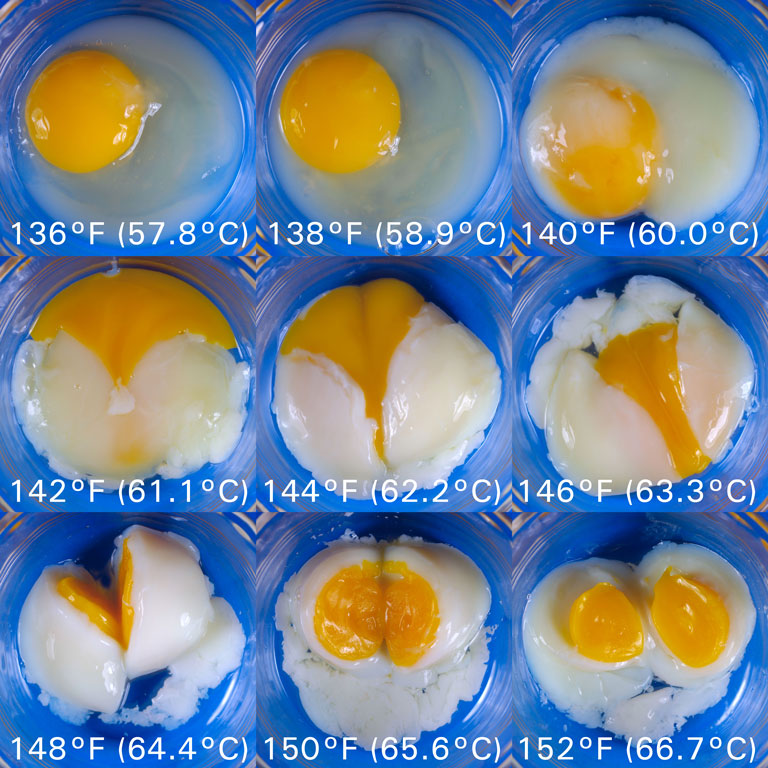
Slow poached eggs are also referred to as 60 minute eggs, or onsen tomago in Japan (onsen being natural hot springs, the story being that eggs are traditionally left by local residents in onsen and, upon being retrieved, are perfectly cooked).  Slow poach eggs are cooked in a water bath at a temperature of 145º for 45 minutes to an hour - resulting in a white that is just set (white but still runny) and a yolk that is beginning to thicken but not yet cooked (which would first begin to turn into a fudge-like consistency before hitting what we think of as hard-boiled).  Because the water never goes above 145º, the eggs are never done past where they should be.  The only downside to the water bath is that it takes a long time and requires a fair amount of planning in advance.  Here is a chart depicting the different doneness of eggs.  Notice that at 144º we are seeing whites turning white but very much still runny.  Also - tangent - it's fucking fascinating that 2 degrees of difference from  146º to 148º causes that much of a change in the yolks.  Eggs are amazing things.

(photo from http://www.douglasbaldwin.com)


Cook's Illustrated recipe for soft boiled eggs was to place the eggs in a steamer for 6 minutes 30 seconds before immediately transferring to an ice bath.  I cut that to 6 minutes 10 seconds because I wanted the yolks to be even runnier (they began setting at 6:30) but otherwise it works like a charm.  I wondered if I could cut that cook time in order to just solidify the whites but not cook them to soft boiled, thus rendering me a soft poached egg.  I attempted to steam 2 eggs with times of 4 minutes and 5 minutes (I made an assumption that cooking time would follow an exponential curve, taking a while to heat up but then heating incredibly quickly after a few minutes).  My results were that the whites on the 4 minute eggs were still mostly clear and uncooked - completely unusable in their current form. The whites on the 5 minute egg were milky and still somewhat runny, and the yolk was thickened.

5 minute egg
It was a  good result, unfortunately I realized that one of my fears had come true.  Because I placed the eggs in a 212º heat source, the whites closest to the shell will always completely set (to a rubbery state).  I ran head on into the very reason that sous vide cookery exists - providing even cooking throughout a product through consistent temperature application.  You can't fake even heating, you can only work around it.  My plans were foiled and my question is answered - you cannot make a slow poached egg in 5 minutes using steam.  However, I would say that cutting Cook's Illustrated's times down did result in a totally usable egg.  For times when I don't want to wait 45 minutes but I want something resembling a slow poached egg, I will be more than happy to quickly steam one to get a similar result.  At least I found a perfectly suitable substitute.  Next time, I will attempt cutting 5 minutes down to perhaps 4:45 or so, to see if it creates noticeable differences in the amount of set whites.  I suspect that it will be difficult to find the precise point where eggs stop being clear and start being whites through steam-based heating though.

Makeshift oyakodon - leftover chicken karaage and tomagoyaki with the 5 minute egg

Saturday, April 20, 2013

Vietnamese Coffee At Home

Needless to say, living in Boston this week has been pretty hectic.  It has been emotionally draining and exhausting, even to those who were not directly impacted by the week's events.  After the week that we have had, a day for rest and creature comforts is a welcome change of pace.

Ever since our trip to Vietnam, I go through periods where I get intense cravings for Vietnamese coffee.  Vietnamese coffee is much different than western coffee, it is incredibly strong stuff - jet fuel by way of coffee beans.  Often served with condensed milk, both hot or iced, it was a treat for me to have in the afternoons, especially during our motorcycle trip through the mountains, when my ears were numb and I had been huffing 2-cycle exhaust for hours.  I had never seen the little drip coffee makers that were ubiquitous throughout Vietnam, so I picked one up in Hanoi before heading home.  I also bought a couple of bags of ground coffee to keep my addiction going.


Of course, upon returning home, I failed miserably at making the small potent servings of coffee, instead getting watery runoff that obviously left most of the coffee flavor in the grounds.  I would search the internet for tips or how-to's and found nothing but advice that did nothing - convincing me of everything from the grounds being both too fine and too coarse, needing to tamp the grinds, or needing an entirely new coffee dripper (which I had a hard time believing considering mine was no different than the ones I saw in Vietnam).  I attempted and gave up several times over the course of a year and a half, before finally coming across the secret.  I hope that sharing this with the blog world will get more westerners into this stuff, because it is absolutely phenomenal.


The coffee dripper can be found on Amazon for as little as $3.  I have seen fancy ones that include clamps and screws for tightening filter plates and all kinds of features, but you don't need anything more than what is pictured above:  a perforated saucer, a well for the grinds and water, and a lid.  You also will need coffee.  You can find coffee beans grown in the central highlands of Vietnam, or some sources say to use coffee with chicory added (Cafe du Monde coffee, based out of New Orleans, is the most widely available source for chicory coffee).  The coffee that I bought in Vietnam did not have any chicory added and I will probably try sticking to a dark French roast when my last bag is empty.  

Start by bringing water to a boil on the stovetop.  If you would like condensed milk, spoon some into a glass (standard amounts are anywhere from ¼-½ of the amount of coffee).  If needed, grind the coffee finely (nearly espresso grind), then add 2-3 tablespoons of coffee to the drip well.  Place the drip well into the saucer and place the whole filter on top of your glass.  When the water is boiling, add JUST enough water to cover the grinds in the well - probably 2 tablespoons or so.  Wait for the grinds to soak up the water, you can check by tapping the side of the well, if the water sloshes then it is not quite ready.  When the grounds are soaked but not sloshing, spoon in enough boiling water to fill up the well, and put the lid on.  It will take a minute or two for the drip to begin but you should see one part of the filter start to drip.  Get ready for liquid gold.


Start to finish, making a cup of coffee could take upwards of 5 minutes.  You can lift the lid to make sure that all of the water has dripped through, and when the coffee is ready, simply take the lid off and flip it upside down.  Take off the saucer/well and place them on the inverted lid and you have a safe and no-fuss way of setting aside your used grounds until you want to deal with them.  Stir to mix in the condensed milk and enjoy.  

Take baby sips and make it last, it is worth it.


Sunday, November 18, 2012

Homemade Vinegar - Beer and Red Wine

Almost 4 months to the day since my last post.  Without a doubt, this has been one of the craziest years of my life.  My work schedule has been unrelenting for a long time now, leaving me with little time to do anything else.  I have managed to squeeze in some good times cooking here and there, making mental notes along the way of things that I'd like to blog about.  At this point I have a backlog of a ton of recipes that I want to put together, so once my work schedule actually does let up, I can get back to this regularly.  Working long hours has forced me to find ways to do interesting things in the kitchen that are not incredibly involved, which has been an interesting change of pace.  One thing that I absolutely can find time to do is put some shit in a bottle and let it ferment.  I stumbled on this article about Charleston chef Sean Brock regarding his love for homemade vinegar.  It looked so simple - I didn't even need to buy ingredients to make it - so how could I not take a shot at it?  I made two kinds; one with a bottle of red wine that had been opened in our fridge for a couple of weeks and was on the downhill slide anyway, and one with a can of Dos Equis that had been left at our house after a summer party.  It was pretty safe to say that I wasn't going to drink it, it was surely destined for beer can chicken or something, so those two bases became my source of vinegar goodness.


Homemade Vinegar

1 part Bragg Apple Cider Vinegar (with the mother)
3 parts alcohol (red wine, white wine, champagne, beer, cider, whatever)

Mix the ingredients together and store in an open container.  Cover the top of the container with cheesecloth or a coffee filter - make sure your cover allows air to reach the vinegar, since air is actually the key ingredient here.  Put your container in a cupboard or garage or basement or something - somewhere dark with a steady temperature.  Allow the vinegar to sit for 4-6 weeks.  Taste it along the way, when it tastes like vinegar, put a lid on it and it is ready for use.  Save the last bit, plus all of the mother, to be your starter for the next batch.

The core of homemade vinegar comes from the vinegar mother, which you can get in stores by buying Bragg Apple Cider Vinegar (on the label it says "with the mother").  Think of vinegar mother in the same sense as bread starter or something, it's the core, the starting point of the vinegar. It is a weird gunky film that is composed of cellulose and acetic acid bacteria (Brock compares it to a jellyfish, I think that is pretty appropriate).  The vinegar creation process is the act of the mother interacting with the air and converting alcohol to acetic acid.  What is really interesting about that process is that few things actually consume alcohol, and acetic acid bacteria is one of them.  The mother is really gross looking, in fact, at first I thought something was wrong with my vinegar, and my wife and I were both super grossed out by it.  It develops as a skin on top of the alcohol where it interacts with air.  Every week I would check on my vinegar and smell it, and swirl the jar to get the mother to mix into the vinegar.  I don't know if that is good or bad, but I assume that if we want air to be in contact with the vinegar and we want the mother to be the interacting agent with the air, then swirling existing gunk into the vinegar and allowing more gunk to form on the top is probably a good thing.  I could be totally wrong though.

I guess the first disclaimer here is that I have not actually used the vinegar in a recipe yet, but I tasted it on its own and it was quite good.  Just look at that red wine vinegar in the photo, it looks like balsamic or something.  It's so thick - and it has all of the characteristics of wine.  It has the initial tartness that you expect from vinegar, but storebought red wine vinegar is just that one note (and is also translucent, but wine is not translucent.. Hmmm.. makes you wonder).  This vinegar is rich, it has body, it still tastes wine-y at the end.  Brock tells a story of inheriting his grandmother's 40 year old vinegar starter and keeping it going.  I can only hope that this experiment kicks off the beginning of a long-lasting vinegar tradition for my yet-to-exist kids and grand kids.

Sunday, July 22, 2012

Carrot Green Pesto Pork Chop w Kale, Carrot and Grilled Corn

I remember when I first decided that I wanted to learn how to cook.  Looking back on it, I had pretty much always been subconsciously interested in food.  I was (am) a total freak about eating certain things - for example, I have to eat Kit Kats by biting off the chocolate on the sides of the wafer bar thing first, then bite off each layer of the wafer one at a time.  I think that at the time when I decided that was how Kit Kats had to be eaten, I was displaying kind of my own weird little kid passion for food.  Fast forward a few years to the summer after my freshman year of college.  Most of my friends were going back to their various homes for the summer, but I decided to stay nearby and work full time.  I got a small studio apartment for what seemed like an exorbitant price of $385/month.  Needless to say, I miss Pittsburgh rent prices.  I was vegetarian and looking for ways to cook for myself that didn't involve Yves deli slices or veggie corn dogs.  I did cook for myself but mostly it was just using TVP and Bragg's amino acids, so pretty much everything tasted like soy sauce.  I wasn't so much interested in having a big recipe book or a ton of cookbooks and having to rely on them for everything, I was far more interested in learning what was needed to cook from scratch.  It wasn't until I met my wife that I began really getting into the practice of cooking.  As someone who cooks for fun, it's hard to find the time needed to really feel comfortable when faced with a grocery store and no idea what to cook, but after about 10 years of active pursuit with lots of trial and error, I feel like occasionally I actually come up with something decent.


This weekend i went to the Union Square farmers market with no particular ideas in mind, I just wanted to come away with some cool stuff to cook with.  I ended up getting some really great stuff - these amazing purple carrots with their greens, some red Russian kale (which I had never seen before), fresh onions, pork chops, and fresh picked ears of corn.  I did a little research on what to do with carrot greens - I didn't want to just throw them out if I could help it - and I saw some other blogs with people doing carrot green pesto.  I decided to base the whole dish around that, with some basic sauteed greens and a carrot and corn salad.

Carrot Green Pesto Pork Chop w Kale, Carrot and Grilled Corn 


1 bunch carrots, with greens
1 bunch kale
1 small onion
½ tsp red pepper flakes
1 garlic clove
¼ c pine nuts
¼ c shredded Parmagiano-Reggiano cheese
2 pork chops
2 ears corn
1 tbsp butter
2 tbsp olive oil
1 tsp sherry vinegar
1 shallot

For the pesto:


Carrot green stems can be incredibly fibrous and difficult to chew, so we are just going to use the fronds.  Pick the fronds from the greens and wash.  Bring a pot of water to boil and blanch the greens for 1-2 minutes.  Drain and press excess water out of the greens.  Add to food processor with pine nuts, salt, and cheese.  Start processing and add a steady stream of olive oil until the pesto starts to come together.  Season to taste with more salt and olive oil.  Set aside.


For Carrot and Grilled Corn Salad


Peel your carrots and slice them thinly into little coins.  Grill the corn until starting to brown on all sides, or if you don't have the means or don't feel like it, just boil the ears for approximately 10 minutes.  Heat a small skillet on low and add the butter.  Saute the carrots until heated through and softened somewhat but not mushy. Cut the kernels off the corn and add to a mixing bowl.  Add the carrots.  Mince the shallot and add to the bowl.  Season with salt and pepper, add 2 tbsp of olive oil and the sherry vinegar and stir well.  Season to taste with salt and pepper.


For the Kale:

This one is easy.  Chop the kale into ½ inch strips.  Dice the small onion.  Heat up a saute pan and add a couple of tablespoons of olive oil.  Add red pepper flakes.  Saute the onion until softened, 3-4 minutes.  Add the kale and saute until wilted, 5-6 minutes.  

For the Pork Chop:

Salt.  Pepper.  Grill.  Or panfry in cast iron, that works too.

For Plating:

Place a bed of kale in the middle of the plate, place your pork chop on top of that.  Top the pork chop with some pesto - maybe 1½ tbsp or so.  Spoon the corn and carrot salad around the edges.  I am not very good when it comes to presentation, but I thought this came out looking really nice.

If I had to make a criticism, I would say that this dish was really crunchy.  Like, the kale is crunch, the carrots are crunchy, the corn is kind of crunchy poppy.  The taste was great all around, the flavors went really well together, but I would have to say that my jaw did get a little tired at the end of this, as weird as that sounds.


Saturday, July 7, 2012

Eastern North Carolina Barbecue

My wife and I spent 3 years in North Carolina - the longest that we have been any one place since moving away from Pittsburgh nearly 10 years ago.  Of all of the places that we have lived, I feel that North Carolina had the strongest sense of local cuisine.  The Raleigh/Durham/Chapel Hill area was by easily the most diverse area of North Carolina that we experienced, but despite a massive influx of people from other parts of the country, the area maintained strong awareness of its roots, and that was inflected on most of the food options around.  Even higher end restaurants still couldn't stray from North Carolina mainstays like pimento cheese and hushpuppies.  Without a doubt, one of the things that left the biggest impact on me was the barbecue.  

Usually cooked whole hog, Eastern NC barbecue is hickory smoked for long periods of time and dressed with an extremely simple, extremely vinegary sauce.  Barbecue is traditionally served finely chopped, which has a very different texture than normal pulled pork or ribs or other types of pork bbq.  Because it traditionally is a whole side of a hog, the chop has a great mix of fat and meat and is insanely good.  It can be served on its own with sides like fried okra, baked beans, black eyed peas or collards.  It can also be served on sandwiches with regular hamburger buns, cole slaw, and pickle slices.  My wife and I miss our favorite barbecue restaurant, called The Pit, with basically weekly regularity, so when we were invited to a 4th of July party this year, I had my heart set from the beginning on some serious fucking barbecue.  I stuck to just using a pork shoulder, as I don't have the means to cook a whole hog, nor do I know even a fraction of the people that it takes to have a true pig pickin, but I think that the shoulder was a worthy substitute.

This turned into a bit of a debacle for me, because my smoker died only 4 hours into smoking the shoulder.  The meat was still at a temp of 140º - nowhere near the 200º that it needs to be - and I noticed that it was dropping instead of rising.  I checked the heating element and realized that it was 100% not on.  Which meant that my pork had been sitting there for probably like an hour without any heat on it.  I was in full panic mode.  I ended up finishing the shoulder in a dutch oven in my regular oven.  At first I was really upset, but it ended up being a great coincidence, because the pot ended up collecting a great mix of pork juice and melted fat that helped to season the shredded barbecue.


North Carolina Barbecue

1 8-9 lb pork shoulder (bone in / skin on)
¼ c ground black pepper
¼ c kosher salt

This is probably the shortest recipe I've ever posted.  It is literally just a seasoned pork shoulder.  The smoke and the sauce do all of the heavy lifting.  This keeps the flavors really simple and straightforward.  Rub the salt and pepper on all sides of the shoulder, especially the exposed meat.  Season up to 12 hours in advance and let it work its magic.  Also, if you can, leave the shoulder out (covered) to come to close to room temperature.  It will make the cooking time more effective.


You can smoke the shoulder a couple of different ways.  As I mentioned in the intro, I used the soon-to-be-dead electric smoker.  You could also do this on charcoal with indirect heat.  Either way, you want to soak your wood chips and get the heat up to about 250º in your cooking method.  Smoke the shoulder until it hits the internal temp of 200º.


This is where things went wrong for me...my smoker ate shit and I had to finish my shoulder in the oven.  I have to say though, this was a great accident for me.  I got my shoulder finished in time, and I got this great mix of fat and pork juice that I wouldn't have had otherwise.  It made things just that much better.  In order to finish the shoulder before the 4th of July party, I had to put the heat at 300º for the oven, but I don't think that it had much effect on the shoulder.

Notice the skin split after most of the fat had rendered out... mmmm
When your shoulder is ready, allow it to rest for at least 30 minutes before shredding.  Unfortunately I cannot vouch for the "authentic" way to chop barbecue, but I suppose that it goes something like this:

- Pull off the large chunks of pork from the bone
- Shred each section with 2 forks - hold the chunk with one hand and using the tines of the fork, shred into small bits
- using a knife, chop the shreds into small pieces.  In my photos, I intentionally left them large because I wasn't sure if the texture would weird out people, so I erred more on the side of traditional pulled pork.

Collect all of the meat in a large mixing bowl, season with salt and pepper and some of the pork juice (should you happen to have any).  Season lightly with the barbecue sauce.  You want it to have tang, but barbecue is always served with sauce at the table so everyone can season to their individual tastes.

Eastern North Carolina Barbecue Sauce

1 c apple cider vinegar
1/4 c brown sugar
1 tbsp dried red pepper flakes
1 tsp salt
1 tsp ground black pepper

Heat up the vinegar in a sauce pan, stir in the rest of the ingredients.  Stir until sugar and salt are dissolved and then allow to cool to room temperature.  I store mine in an old Scott's barbecue sauce bottle because it so perfectly dispenses the sauce.


Tuesday, May 22, 2012

Homemade Ramen

I guess that at this point, the regularity by which I write blog posts that somehow relate to the Momofuku cooking might be getting kind of repetitive.  It has become quite a reliable source of deliciousness for me, and it has been a great entry for me personally to become more well versed in pseudo Japanese food, especially since I generally stick to the Noodle Bar recipes. Since acquiring the book, I have been eyeing up the idea of attempting to make the ramen totally from scratch - after all, it is the fucking Super Bowl of the Noodle Bar recipes.  The one blocking issue for me has always been the noodles.  David Chang mentions that the ingredients are hard to find (I know that I have never come across them) so I always kept that one on the back burner.  Until now.  A coworker of mine was kind enough to lend me the debut issue of Chang's new quarterly called Lucky Peach.  In it, I was shocked and excited to find that all that was needed for homemade ramen noodles was simple basic (see what I did there?) baking soda.  I could barely wait until the weekend to get this project started.  It turned out to be a nearly 2 day task to put all of this together, but I have to say it was absolutely worth it.  The weekend of work was summarized by my wife at the dinner table Sunday night with a succinct summary of "dude, you made fucking ramen."  


The ramen related recipes here are as follows:
- Stock
- Stock seasoning (tare)
- Roasted pork belly (chashu)
- Stewed bamboo shoots (menma)
- Noodles
- Slow poached egg (onsen tamago)


Roasted Pork Belly / Chashu

2-3 lb pork belly
¼ c salt
¼ c sugar

If the pork belly is skin on, remove the skin.  Mix the salt and sugar together and dredge the pork belly in the cure mix on all sides.  Cure in the refrigerator for at least 6 hours but no more than 24.  


Preheat the oven to 450º.  Roast the belly for 1 hour, basting occasionally with the fat that is rendered from the belly.  Reduce heat to 250º and roast for another hour.  Allow pork belly to cool, then refrigerate until the fat solidifies.  Once it is chilled, it will be easier to slice in thin slices.


Tare

1 c soy sauce
½ c sake
½ c mirin
1 chicken back or equal amount chicken bones

Roast the bones in a 425º oven for an hour or until the bones are well browned.  If you can roast the bones in a saucepan without steaming them instead then do that, otherwise roast in a small open dish and when the bones are roasted, deglaze the pan with the liquid.  Simmer for an hour, until the liquid is slightly reduced and thickened.


Stock

So some background on this... The Momofuku cookbook has a ramen recipe, but Lucky Peach featured Momofuku Noodle Bar's "Ramen 2.0" recipe, where the goal was to reduce the cost of the ramen broth by making it just as flavorful without needing as much pork or chicken parts.  I ended up kind of shooting from the hip here and combined the two of them because I can't leave well enough alone.  I think it turned out pretty great.

3.5 lb pork necks
3 lb chicken backs or other parts
1 onion or leek roots and ends from 1 bunch leeks, washed
2 c dried shiitakes
6 quarts water
2 pieces konbu
6 oz bacon

Heat the oven to 400º.  Rinse the konbu and set aside.

Start the stock by heating the water to 160º.  Turn off the heat and add the konbu.  Cover the pot and let the konbu steep for an hour.  According to Lucky Peach this is some crazy Japanese science way to extract the most flavor out of konbu.  I am not one to debate this.

As the konbu is steeping, start roasting the pork necks.  Roast them for about an hour, turning as necessary, you want them to be brown but not black.  Nicely roasted.


When the konbu is done steeping, remove it and discard or save for another use.  Rinse the shiitakes and then add to the stock.  Bring the water up to a boil and then turn the heat down until the broth is simmering.  Simmer for 30 minutes. 

Remove the mushrooms from the stock and add the chicken bones.  Keep the water at a heat of about 180º if you can.  Skim the foam and impurities that gather on the surface often.  Give the chicken at least an hour (maybe more if you have the time).  If you are using smaller parts then you will extract the flavor faster. If you are using whole carcasses then maybe err on the longer side.  

Remove the chicken bones and add the roasted pork bones along with the bacon.  Now you are entering the long part of the stock making process.  Keep the water at 180º, continuing skimming, for 6-7 hours, or as long as you can feasibly do it.  Remove the bacon after an hour and discard it.  Add water as necessary, keeping the bones fully covered.


In the last hour, add your leeks or onions and let them steep and lend their freshness to the broth.


Strain out the broth using a cheesecloth lined colander.  You may have to remove the bones by hand first if they are too big.

Here is a picture of the consistency of the stock after it has been chilled.  It was seriously like jello, sooo much gelatin.  So good.


Stewed Bamboo Shoots (Menma)

1 c canned or prepacked boiled bamboo shoots
1/2 c soy sauce
1 tbsp sesame oil

I found these neat boiled and packed bamboo shoots at the Japanese grocery store, so I thought it was worth taking a picture of them in their pristine state.  If you are using canned bamboo shoots, just drain and mix all the ingredients and bring to a simmer.  Stew for 20-30 minutes and let cool.


Alkaline Noodles

I actually ended up making 2 batches of these.  Lucky Peach's recipe called for 3 c AP flour, but I found the dough to be far too stretchy even after 2 kneading sessions.  The second time, I used half bread flour and half AP for a more glutenous flour.  The resulting dough was perfect - stiff enough to roll out using a pasta machine without tearing, but with enough give to remain malleable.  These noodles can also be used for the momofuku ginger scallion noodles which are really awesome.

1.5 c bread flour
1.5 c all purpose flour
1 c lukewarm water
4 tsp baking soda

Heat oven to 250º, spread baking soda out on aluminum foil and bake for 1 hour.  This will remove the carbon dioxide from the baking soda, leaving you with sodium carbonate - the alkaline salt that makes these noodles hold up to hot soup broth and have that slightly kind of nutty flavor to them.

Dissolve the baking soda in the lukewarm water and stir until it is fully dissolved.

In a mixing bowl, add the flour and then the water.  Stir with a fork until the dough becomes shaggy, and then begin kneading with your hands.  Work dough for 5 minutes, wrap with saran wrap and allow to rest for 20 minutes.  Work the dough again for another 5 minutes, rewrap, and refrigerate for 1 hour.


Roll out either with a pasta machine or by hand.  I used a pasta machine on the following settings.  I rolled the sheets out to a thickness of 3 (that is, 3rd setting from the thinnest possible).


I then used the thinner of the pasta cutters (linguine?  I don't even know - the one that is smaller than fettucine).  I found that I had to start the dough through the cutters and then actually grab the end of the cut noodles and pull through as I continued to cut.  If i didn't do that, I ended up getting very ratty bunched up noodles.  By pulling, the noodles cut sharply and slid right through.  A friend also told me that spraying a little Pam or spray canola or whatever on the cutter blades before cutting the noodles also made a world of difference when he made these noodles - I definitely plan on trying that next time.


Onsen Tamago (Slow poached eggs)

Check out my old recipe for these awesome and incredibly versatile eggs:

Serving your ramen:


Ingredients:
Stock
Tare
Menma
Eggs
Thinly sliced green onion
Sheets of nori (optional)
Alkaline noodles
Pork

Ok holy shit we are almost finally to the point where you can eat.  You've done all the hard work, congratulations.  Now you just need to put the pieces together.  It's really easy now.  Boil your noodles and then drain them.  Use the tare to season your ramen stock.  Add water if necessary if the broth is too strongly flavored.


Place a serving of noodles in the bowl, slide a piece of nori down along the wall of the bowl.  Place a few slices of pork on top of them justified to one side.  Ladle hot broth over the noodles.  Placed some menma on the other side of the bowl, crack open an egg and let it slide into the middle of the bowl.  Top with green onions.  You are finally ready to enjoy the fruits of your labor, take a deep breath and then eat the shit out of this awesome ramen.


Saturday, March 31, 2012

Tasso - Cajun Smoked Ham

So lately I have been trying to pick up larger cuts of meat and do various things with them.  I use the excuse of economy but the underlying truth is that I enjoy amateur butchery.  In addition to that, it is definitely convenient to buy a 3 lb chuck roast, have it sitting in the freezer, and be able to fit many whims with it.  Beef stew?  Ground beef?  Shaved beef for cheesesteaks?   I have a wide variety of bases covered.  Keeping it locked in vacuum bags extends the freezer life so I have the luxury of using one large cut over a couple months.  The downside to this (if you could call it a downside) is that occasionally I find myself wanting to get rid of things so that I can pick up something else, or feeling the need to make something with a certain cut before freezer burn, the inevitable asshole, sets in.

Last weekend I found myself wanting to get rid of the last of a pork shoulder.  I had about 1½ lb of shoulder that I wanted to use.  I had a hankering to break out the smoker and do something cured/smoked, because I didn't intend on using the shoulder immediately.  The first thing that came to mind was to make tasso - the ubiquitous ham used all throughout Cajun cooking.  

I think tasso often gets a comparison to bacon.  They are used in similar ways, primarily as a seasoning ingredient for bigger meals like jambalaya.  They are both cured, but tasso is a very quick cure compared to bacon, which can take up to a week.  Tasso cures for a matter of hours on much smaller cuts of meat.  Tasso uses shoulder, whereas bacon uses belly, and tasso uses a strong spice rub, lending a complex flavor profile after smoking.

Traditionally, tasso is smoked using pecan wood.  I had to settle for a mix of alder and hickory (1:2 ratio), I wanted a smoked flavor but not too strong.  Alder is a nice mild wood often used for smoking fish, so I relied mostly on that with a little bit of hickory to give it a little backbone.


Tasso - Cajun Smoked Ham

(recipe adapted from Charcuterie by Michael Ruhlman)


Cure:
1.5-2 lb pork shoulder, cut into roughly 1" thick slabs
8 oz kosher salt
4 oz sugar

Rub:
1½ tbsp ground white pepper
3/4 tbsp cayenne pepper
1½ tbsp dried marjoram
1½ tbsp ground allspice

Start by combining the salt and sugar for your cure.  Dredge your shoulder cuts in the cure, shake off excess, and set them in a container to cure for 4 hours.  You could add pink salt to the cure, I opted not to.  In this cure you would use 1 oz of pink salt.


Combine the rub ingredients.  I had to use the old fashioned mortar and pestle to grind my white pepper so it is extra chunky.  I got tired and my mortar and pestle are small and kind of hard to use.


Rinse the shoulder slabs and pat them dry with a paper towel.  Use your hands to work in the rub on all sides of the shoulder.


Get your smoker preheated to 180º.  Soak the wood chips for at least 30 minutes, add them to the smoker and watch for first whisps of smoke to come out.  Add the tasso and smoke to a temperature of 155º.  Add woodchips as necessary.  Let cool and use as needed or freeze for future use.